David Wood, Newburyport, Massachusetts. A Dish Dial Massachusetts Shelf Clock. BBB-21.
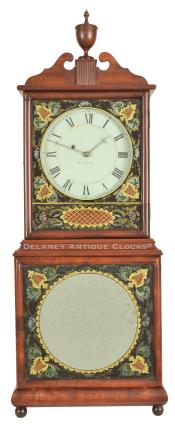


The Roxbury group of clockmakers popularized this classic Boston case form. It is an empire form and is considered by many to be the last shelf clock form made in quantity by artisan clockmakers. The next popular shelf clock forms created in this country were made in factories.
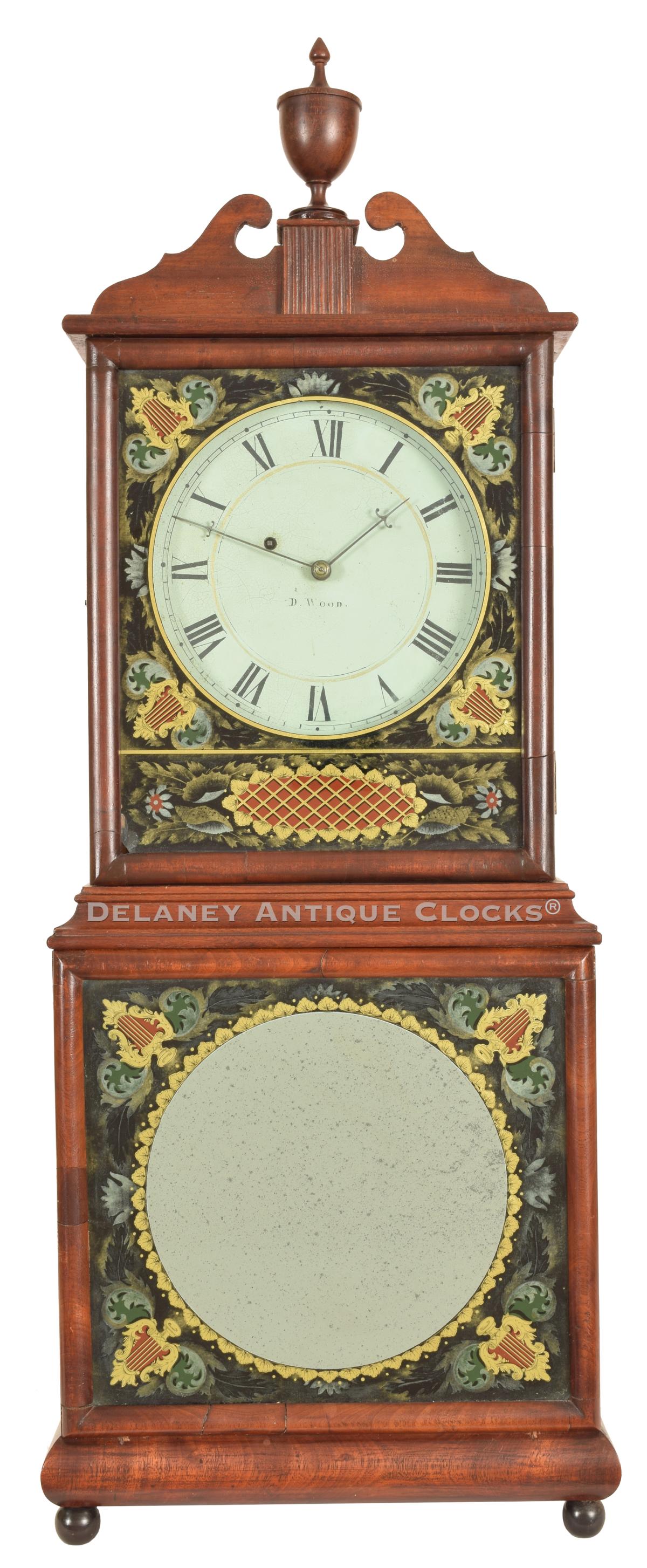
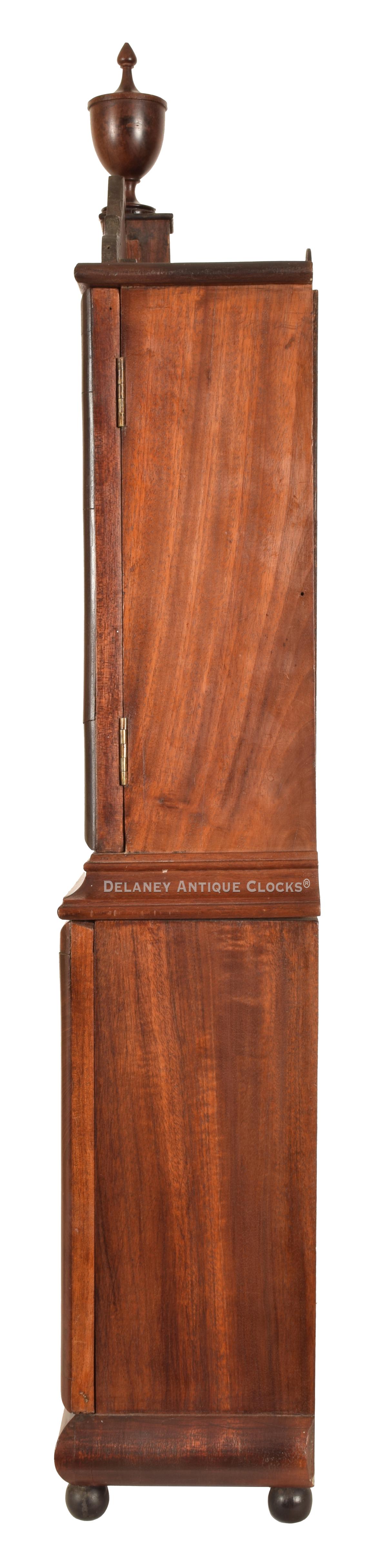
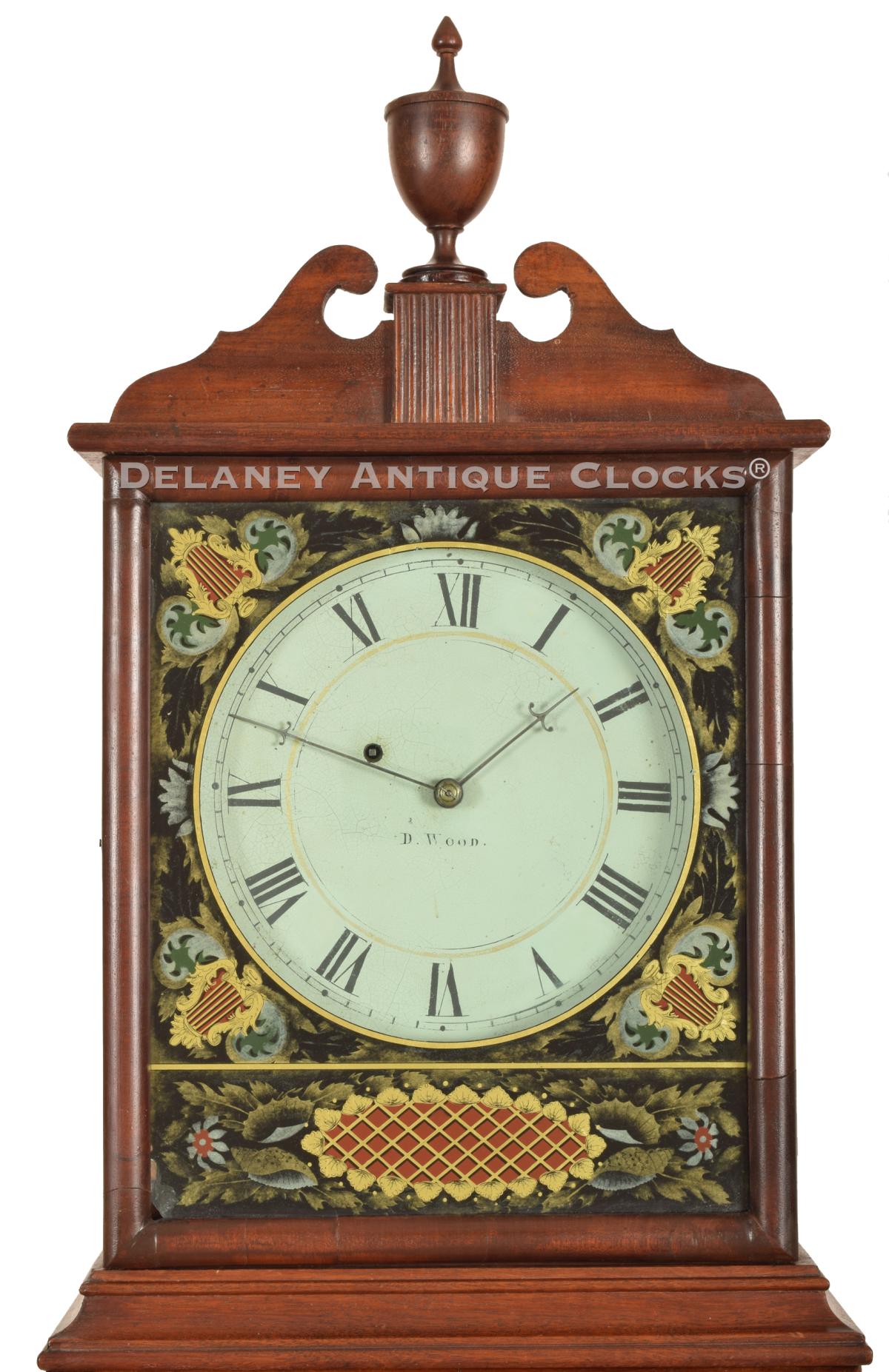
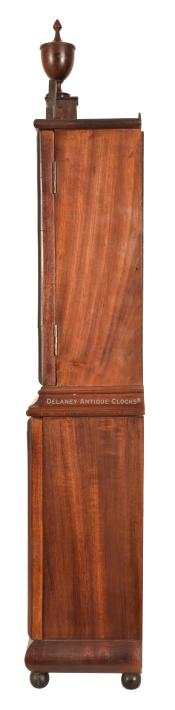
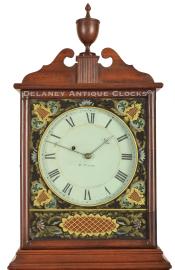
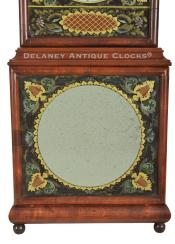
This mahogany case retains a pleasing shellac finish that appears to be 50 or more years old. Four turned wooden ball feet are applied or secured to the bottom of the case- one at each corner. They elevated the cabinet off the shelf or mantel. A pillow-shaped mahogany molding visually supports the half-round mahogany frame and period mirror. The colorfully painted decoration framing the mirror is applied from the back. This has been fully restored and expertly executed. The harp and floral theme and colors in this design match the decoration in the upper glass. The upper section of the case is called the bonnet or hood. It is removed in the same manner as a tall case clock bonnet. The hood slides forward. It also has a door that is hinged on the right, allowing you to access the hands and winding square. The bonnet door is framed in half-rounded moldings. This framing supports a reverse-painted glass tablet. This glass tablet is also an older repaint of excellent quality. The colors and the detailed work are outstanding. Musical string instruments, a harp, are depicted in each of the four corners. Floral and foliage themes create the background. A gilt circle frames the open in which one views the dial. A nicely shaped fret pattern at the top of the hood centers a reeded finial plinth. A turned mahogany urn-shaped finial sits atop the plinth.
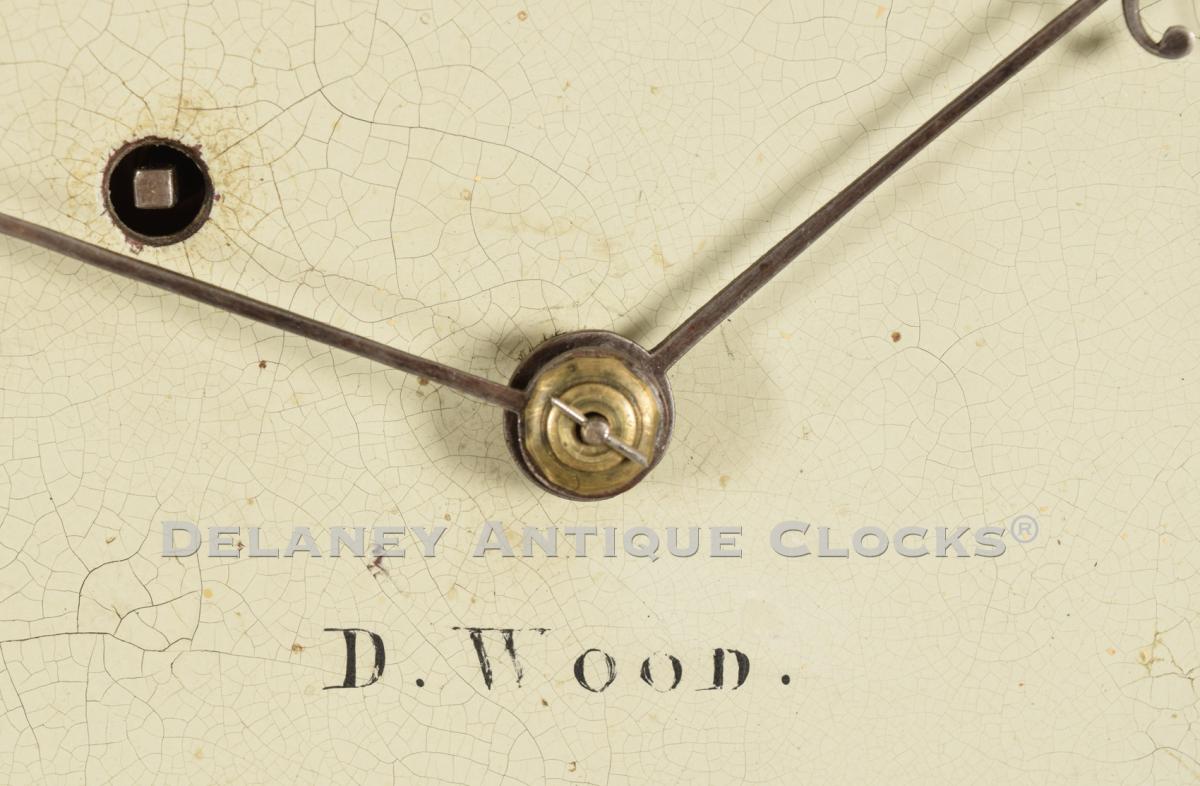
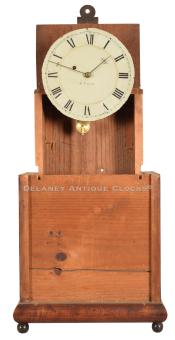
The dial is accessed by opening the door. Once opened, it is evident that the dial is framed with a dial mask of pine and painted red. This red paint is original. The circular-shaped iron dial is a convex form. It features a closed-minute ring and Roman-style hour numerals. A gilt circle frames the inside of the time ring. This dial is signed. The signature reads “D. WOOD” across the center. The hands are skillfully filed and feature the design of arrow pointers.
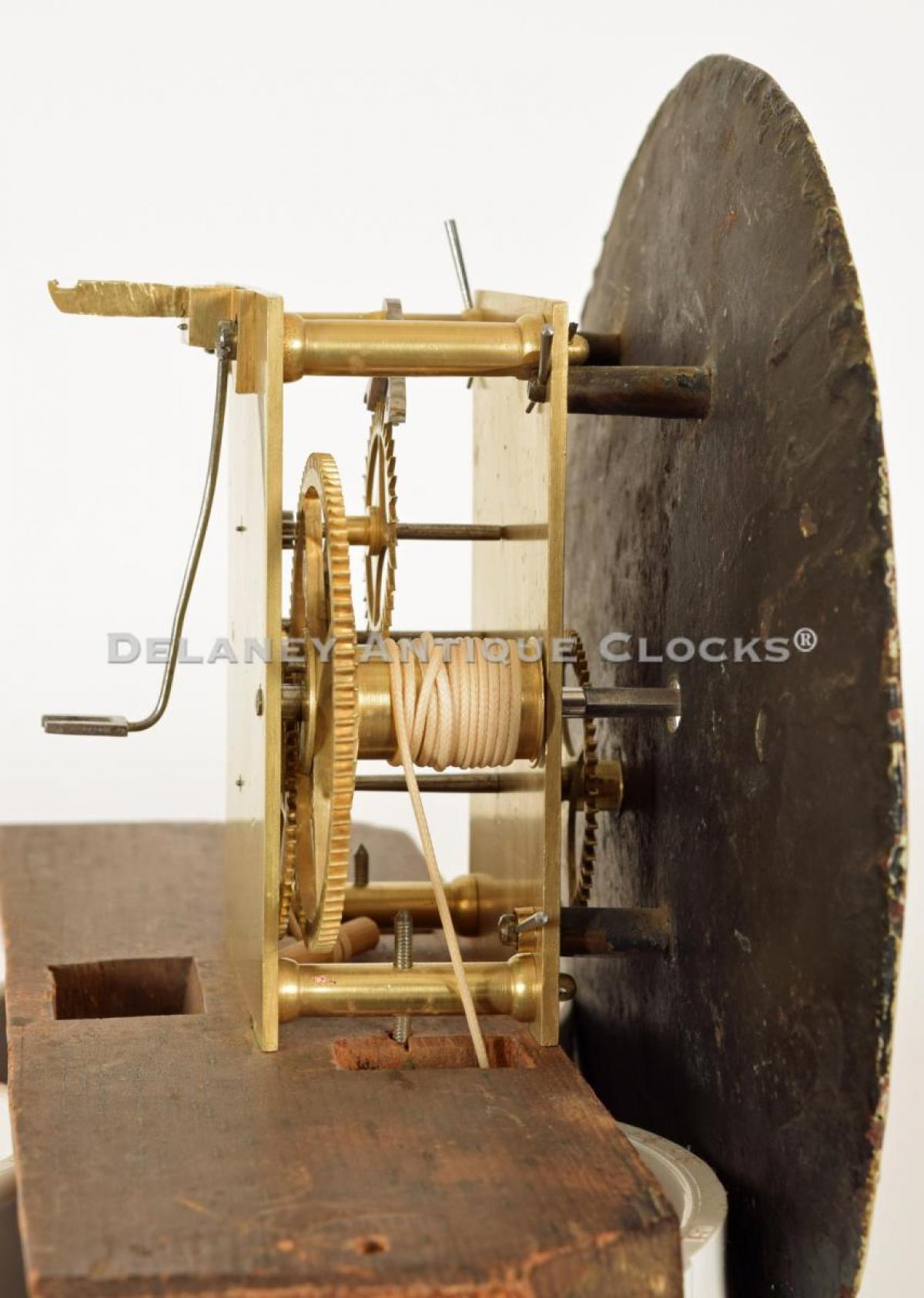
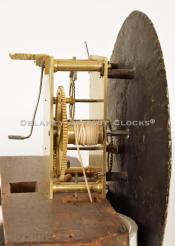
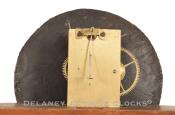
The weight-driven movement is made of brass. Four-shouldered brass posts secure the rectangular-shaped plates. This frame supports the hardened steel shafts, brass gearing, smoothly turned winding drum, and recoil escapement. This timepiece is designed to run for eight days on a full wind. The cast-iron weight descends directly below the works. The pendulum hangs from a bridge mounted on the backplate.
This is an unusual form for David Wood, a clockmaker who left a significant mark in the history of clockmaking. He made this example circa 1820, a time when his unique style and craftsmanship were at their peak.
The case measures approximately 34.75 inches tall to the top of the finial, 13.25 inches wide, and 5.75 inches deep.
Inventory number BBB-21.
David Wood was born the son of John Wood (1727-1805) and Eunice (Fellows) Wood (1737-1801) in Newburyport, Massachusetts, on July 5, 1766. It is thought that he may have been apprenticed to either Daniel Balch Senior or to one of the members Mulliken family. All of whom were prominent Clockmakers in this region. David advertised in the Essex Journal and New Hampshire Packet on June 13, 1792, that he had set up a shop in Market Square, near Reverend Andrews Meeting House. Three short years later, he married Elizabeth Bird (1769-1846) of Newbury in 1795. It has become evident that David Wood was also a Retailer. In 1806 he advertised that he had for sale "Willard's best Patent Timepieces, for as low as can be purchased in Roxbury." In 1818, he and Abel Moulton, a local silversmith, moved into the shop formerly occupied by Thomas H. Balch. In 1824 he advertised that he had moved on the westerly side of Market Square opposite the Market House. After his wife's death in 1846, he moved to Lexington to live near his son David, who was a merchant in that town.
It has become quite obvious to us that David Wood was a very successful Clockmaker and Retailer of Clocks. Over the last 35 years of being in the business of selling clocks, we have sold many examples of wall, shelf, and tall case clocks bearing this Maker's signature on the dial.