E. Howard & Co., Boston, MA. Model No. 80. Tall case clock. Quarter striking Grandfather Clock. 214057.
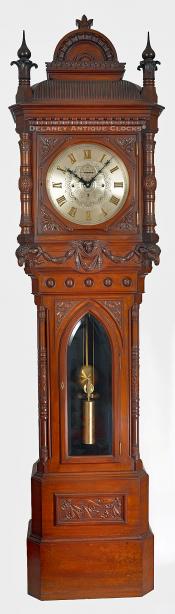

This impressive mahogany case measures approximately 8 feet 11 inches to the top of the center finial. It was made by the E. Howard Clock Company of Boston, Massachusetts. It was originally ordered on May 10, 1888, and shipped out eight days later on the 18th to F. L. Wilson, a jeweler working in Danbury, Connecticut, at an original cost of $600. It was most recently in the care of the Sisters of Mercy of the Americans. This is an elderly care building on the property of the Searles Castle in Windham, New Hampshire.
This mahogany case retains its original finish. The decorations are finely made to the highest standards of craftsmanship. These decorative details are located throughout the design of the case. The top terminates in a sarcophagus top. Two carved finials are positioned on the outer corners. The half-round detail is fitted with the top section of a carved fleur-de-lis. The bonnet detail then steps down to form the main structure. The square-shaped hood door features an octagonal shape window framing. It is fitted with a crystal plate that protects the dial. The corners of this door are decorated with floral carvings. The side of the hood features fully turned columns that are also decorated with carved details. The waist section is tapered inward. Carved ram's heads are located at the upper corners. An elaborately carved swag and a central winged cupid is the central feature. This is positioned over the lancet-shaped beveled glass door. This door is flanked by smoothly turned and carved columns. The base sits flat on the floor. It features a double step and a carved decorative panel.
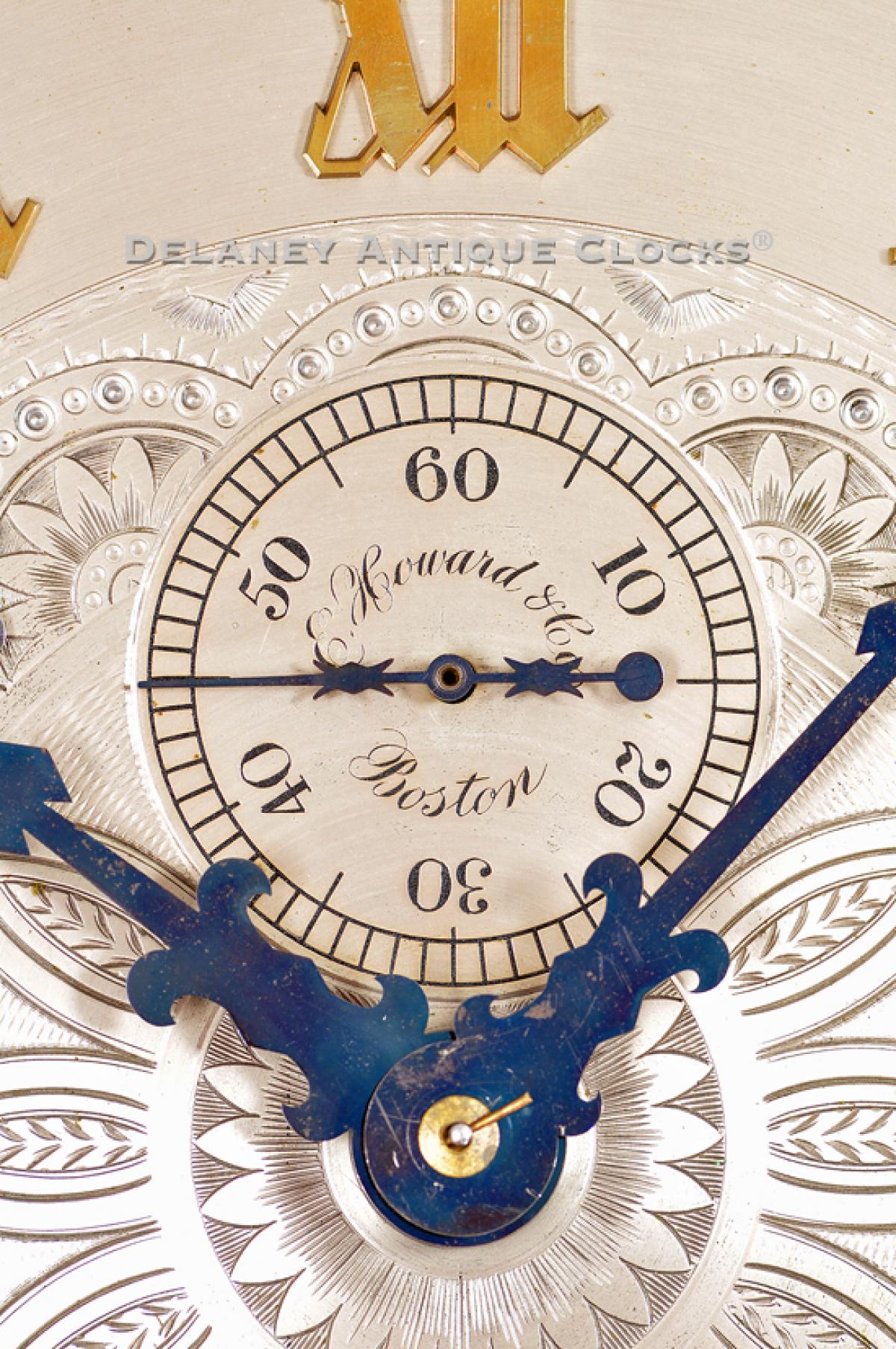
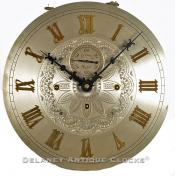
The dial is brass and measures 15 inches in diameter. It is decoratively engraved and engine-turned. The front surface has been silvered, and the minute and seconds divisions are treated with a black enamel. The hour numerals are applied to the front of the dial. They are raised and treated in a gilt wash. This dial is inscribed "E. Howard & Co. / Boston" within the subsidiary seconds dial.
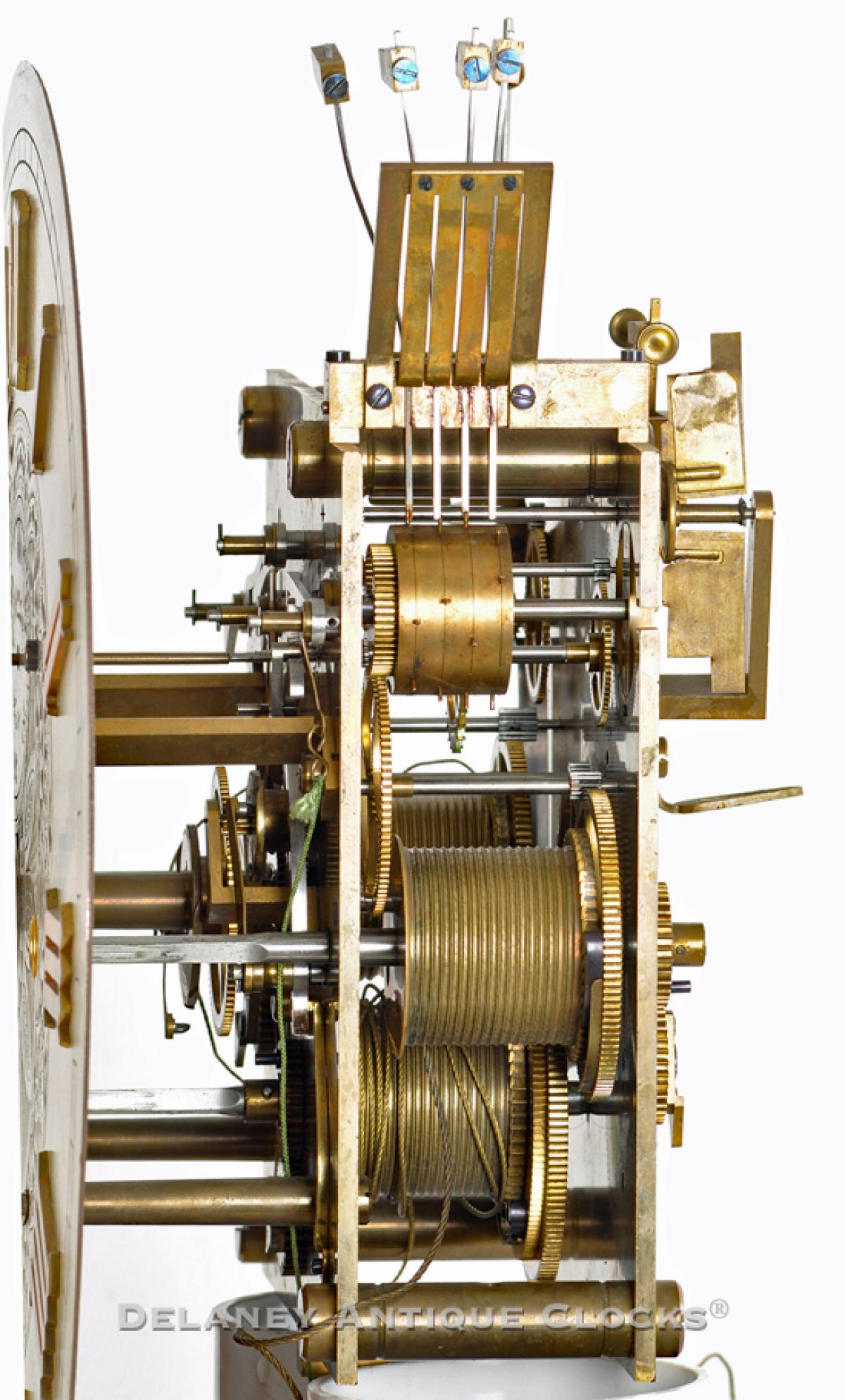
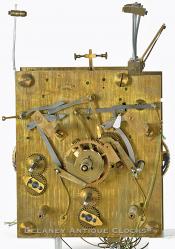
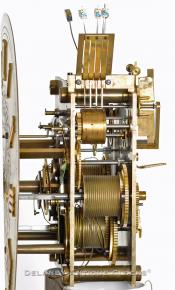
The eight-day time, strike, and quarter-hour Westminster chiming movement is very highly finished throughout. The heavy brass plates are decorated with damascene. The mechanism is designed with a Graham Dead Beat escapement and maintaining power. The hours are struck on a deep-toned cathedral gong. The quarter hours are signaled by playing Westminster Chimes on wires gongs. All of which are mounted to a sound board above the movement. The three weights are finished in brass sleeves that are polished. The gilded cherry pendulum rod supports a brass-faced pendulum bob. The pendulum tie-down is also brass.
Inventory number 214057.
The E. Howard & Company succeeded the Howard & Davis firm in 1857. The Howard & Davis firm was comprised of Edward Howard and David Porter Davis and was established in 1842 in Roxbury, Massachusetts. Both men had just completed their clock apprenticeship under the guidance of Aaron Willard Jr in Boston. The Howard & Davis firm made high-grade clocks, precision balances, sewing machines, fire engines, and watches. After the dissolution of Howard & Davis, Edward Howard became Boston's leading manufacturer of weight-driven residential and commercial clocks. The firm also made a large number of tower clocks and watchman and salve clock systems. These sold well in the last quarter of the 1800s.
It has been said that the E. Howard Clock company never made an inexpensive clock, and everything they made was of very good quality. As a result, Howard clocks have become very collectible and are prized by their owners. Today, the E. Howard name enjoys outstanding name recognition.
For a more in-depth reading of Edward Howard and his various businesses, please read "Willard's Patent Time Pieces," written by Paul Foley.