
E. Howard & Co., of Boston, Massachusetts. The Model No. 7, "House and Counting-Room Clocks." TT-81.
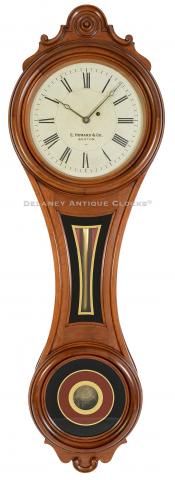
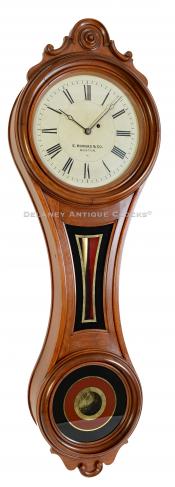

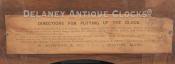
This very impressive wall timepiece is cataloged as the Model Number 7. It was manufactured by the E. Howard & Company of Boston, Massachusetts, and was originally marketed as being "Well adapted for banks, insurance offices and large rooms." Of the five E. Howard & Company Figure Eight sizes, the No. 7, is arguably the most difficult model to find. As a result, this is considered a rare clock and the most important version to find if your goal is to assemble the entire set of five.
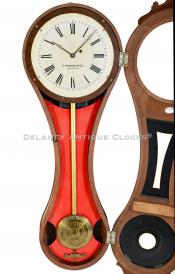
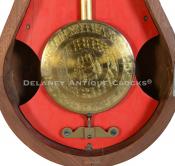
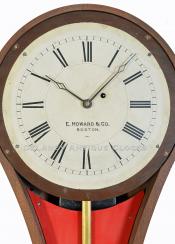
The No. 7 case measures 4 feet 2 inches long and is second to the largest example of the five individual sizes. This example is constructed in black walnut and retains its original finish, which has been recently enhanced and rubbed down. The color is excellent. The front of this case serves double duty. It is hinged on the right and opens to access the case's interior. The flat molding in the middle section is an interesting construction detail that the door incorporates in its design. Most figure eight forms are flat in this location. This door is fitted with glass. The upper glass is clear, and through it, you are able to view the dial. The middle tablet or throat glass is decorated in black and gold from the back. The center section is left clear so that you can view the motion of the gilt wooden pendulum rod. The lower circular tablet is painted in the traditional E. Howard colors of black, red, and gold. The center of this is also left clear to view the brass-faced pendulum bob. Both painted tablets are in good original condition.
The heavy iron dial on this clock measures 12 inches in diameter and is in very good original condition. It is painted with a heavy coat of paint. The hours are indicated with Roman-style figures. The Company name is signed below the center arbor in an unusual block-style lettering. It reads, "E. Howard & Co., / Boston." This is an original signature.
The hands are fitted with open diamonds out on the ends.
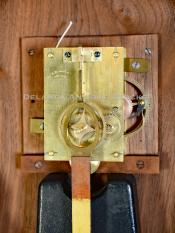
The weight-driven movement is constructed in brass and is of good quality. The Maker's name is die-stamped into the front plate in the upper left corner. The plates a quite heavy and were originally finely finished. This movement features a recoil escapement. The pendulum is suspended from the bridge, which is mounted to the top of the movement. The rod is made from straight-grain cherry. Before it was constructed, the wood was appropriately seasoned and gilded. It now retains this original treatment. The bob is zinc and covered with a brass jacket. The brass is decorated with several engraved concentric rings. Every other one is decorated with a damascene design. A cast-iron weight powers this movement designed to run for eight days on a full wind. The weight is stamped with the number two and is original to this clock.
This clock was made circa 1870.
Inventory number TT-81.
The E. Howard & Company succeeded the Howard & Davis firm in 1857. The Howard & Davis firm was comprised of Edward Howard and David Porter Davis and was established in 1842 in Roxbury, Massachusetts. Both men had just completed their clock apprenticeship under the guidance of Aaron Willard Jr in Boston. The Howard & Davis firm made high-grade clocks, precision balances, sewing machines, fire engines, and watches. After the dissolution of Howard & Davis, Edward Howard became Boston's leading manufacturer of weight-driven residential and commercial clocks. The firm also made a large number of tower clocks and watchman and salve clock systems. These sold well in the last quarter of the 1800s.
It has been said that the E. Howard Clock company never made an inexpensive clock, and everything they made was of very good quality. As a result, Howard clocks have become very collectible and are prized by their owners. Today, the E. Howard name enjoys outstanding name recognition.
For a more in-depth reading of Edward Howard and his various businesses, please read "Willard's Patent Time Pieces," written by Paul Foley.


