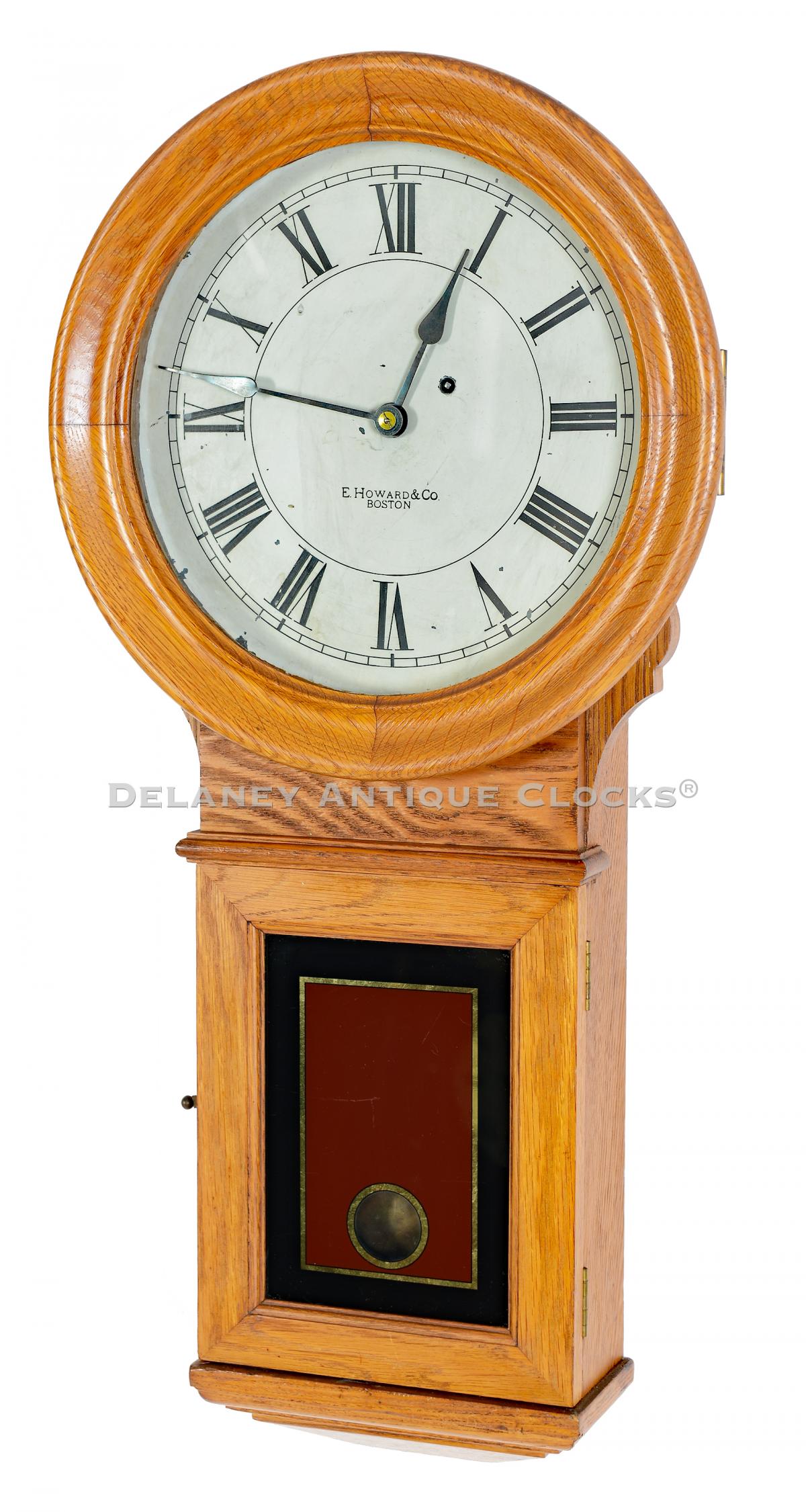
E. Howard & Co. Model No. 70-12 wall clock. Boston, MA. 223027.





This latter model, number 70, is in excellent overall condition. The case is constructed of oak and retains a very light finish.
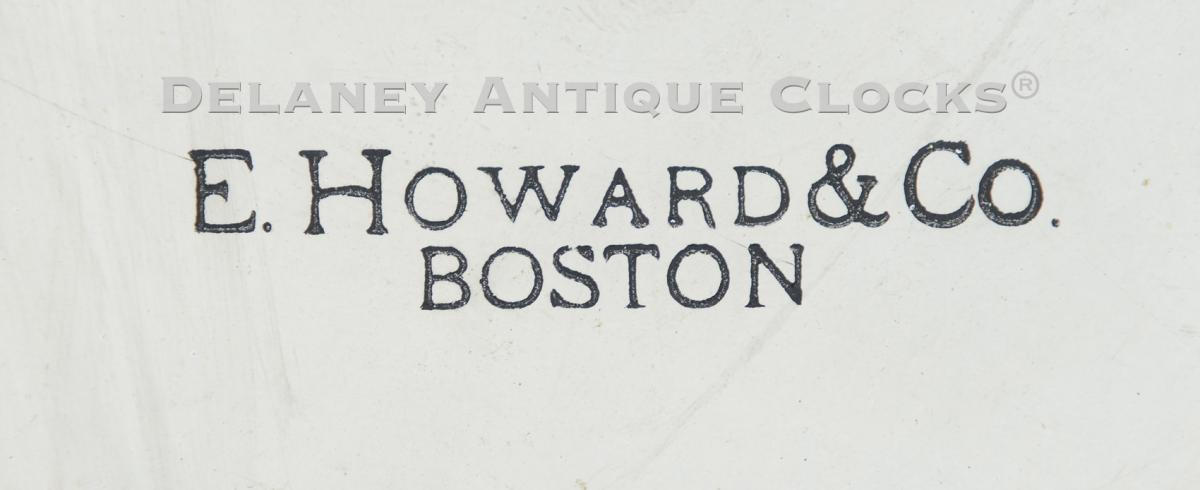
The clock's dial is zinc and measures 12 inches in diameter. It is paint-decorated and is in original condition. The dial format features a closed minute ring and large Roman-style hour numerals. It is signed in block lettering, E. Howard & Co. / BOSTON. Spade-shaped hands display the time. Behind the dial is the weight-driven movement.
The brass, eight-day, weight-driven clock mechanism is of excellent quality. The Howard Clock Company guaranteed this model not to vary more than one minute a month. The movement is secured in the case with four screws that thread into the backboard. Access holes are drilled into the front plate. Four-turned pillars support the two rectangular-shaped brass plates. The plates are finished in nickel. The Maker's name and model number "70" are die-stamped into the front plate. Hardened steel shafts support the polished steel pinions, brass gearing, and recoil escapement. The pendulum hangs from the bridge on the front of the movement. A wooden rod supports a bob that is zinc and covered in brass. The bob swings in front of a painted wooden weight board. The cast iron weight is stamped with the number "70." The lower door features a painted glass. The paint is applied from the back in the traditional Howard colors of black, red, and gold.
This fine example was made circa 1910. The case measures approximately 32 inches long overall.
The Model 70 was successfully sold. It was used extensively in the Boston Public School System, in the various Boroughs of Greater New York, and in many other places as the Standard School Clock. The United States Government specified it as the "Standard for all Public Buildings." One would also see this model in many of the nation's railroad stations, including The Elevated Railroad Stations of New York City, The Pennsylvania Railroad Company, The Central Railroad of New Jersey, The West Shore Railroad of Boston & Albany, and nearly all Railroad Companies throughout the United States, Mexico, and Canada.
It is inventory number 223027.
The E. Howard & Company succeeded the Howard & Davis firm in 1857. The Howard & Davis firm was comprised of Edward Howard and David Porter Davis and was established in 1842 in Roxbury, Massachusetts. Both men had just completed their clock apprenticeship under the guidance of Aaron Willard Jr in Boston. The Howard & Davis firm made high-grade clocks, precision balances, sewing machines, fire engines, and watches. After the dissolution of Howard & Davis, Edward Howard became Boston's leading manufacturer of weight-driven residential and commercial clocks. The firm also made a large number of tower clocks and watchman and salve clock systems. These sold well in the last quarter of the 1800s.
It has been said that the E. Howard Clock company never made an inexpensive clock, and everything they made was of very good quality. As a result, Howard clocks have become very collectible and are prized by their owners. Today, the E. Howard name enjoys outstanding name recognition.
For a more in-depth reading of Edward Howard and his various businesses, please read "Willard's Patent Time Pieces," written by Paul Foley.