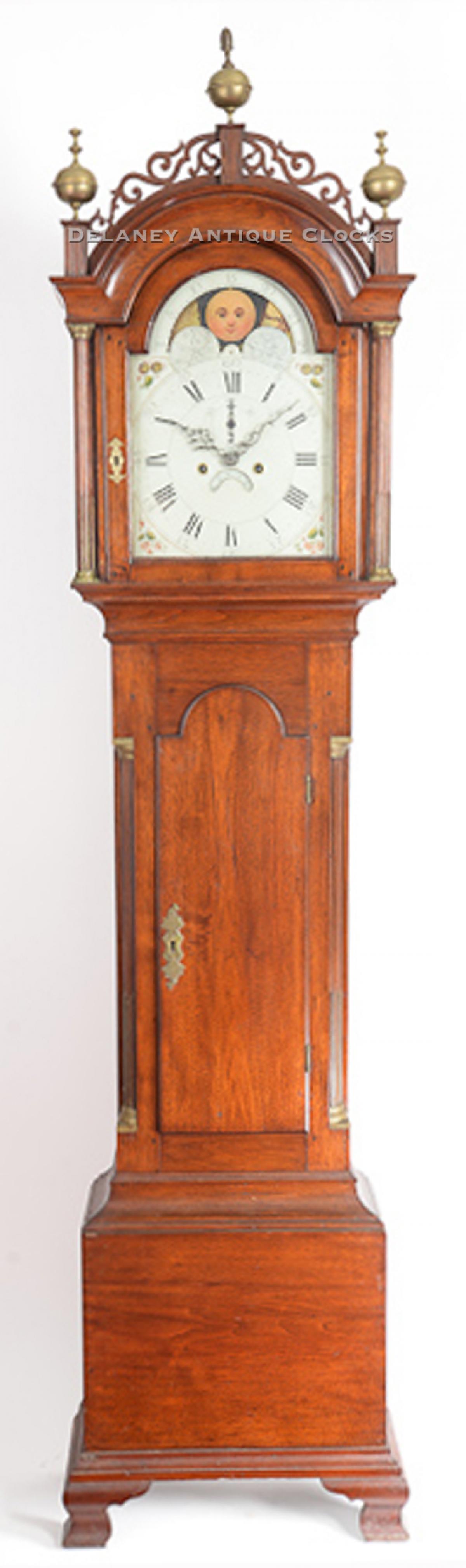
Ezra Batchelder of Danvers, Massachusetts. A Butternut case tall clock. 217003.
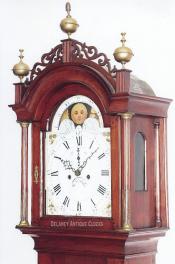
This clock stands on four boldly formed and original ogee bracket feet. The waist is fitted with a tombstone-shaped door. This door is trimmed with a molded edge. The sides of the waist are fitted with fluted quarter columns that are stopped with brass rods. These terminate in brass quarter capitals. The hood features a simple molded arch molding surmounted with a New England-style fretwork pattern. The frets are original to this clock and exhibit a nice variation of the traditional theme. Fluted finial plinths support the three large period brass-and-ball and spiked finials. The bonnet columns are also brass, stop-fluted, and terminate in brass capitals. The bonnet door is arched in form and fitted with glass. Behind it is the painted iron dial.
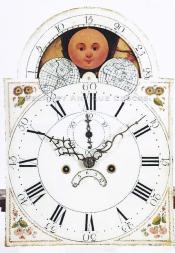
This iron dial measures 12 inches across, is paint-decorated, and features a lunar calendar in the arch. Each of the four spandrel areas is decorated with representations of floral patterns and cherries. This dial displays the hours, minutes, seconds, and calendar dates in their traditional locations. Please note the wonderfully shaped steel hands.
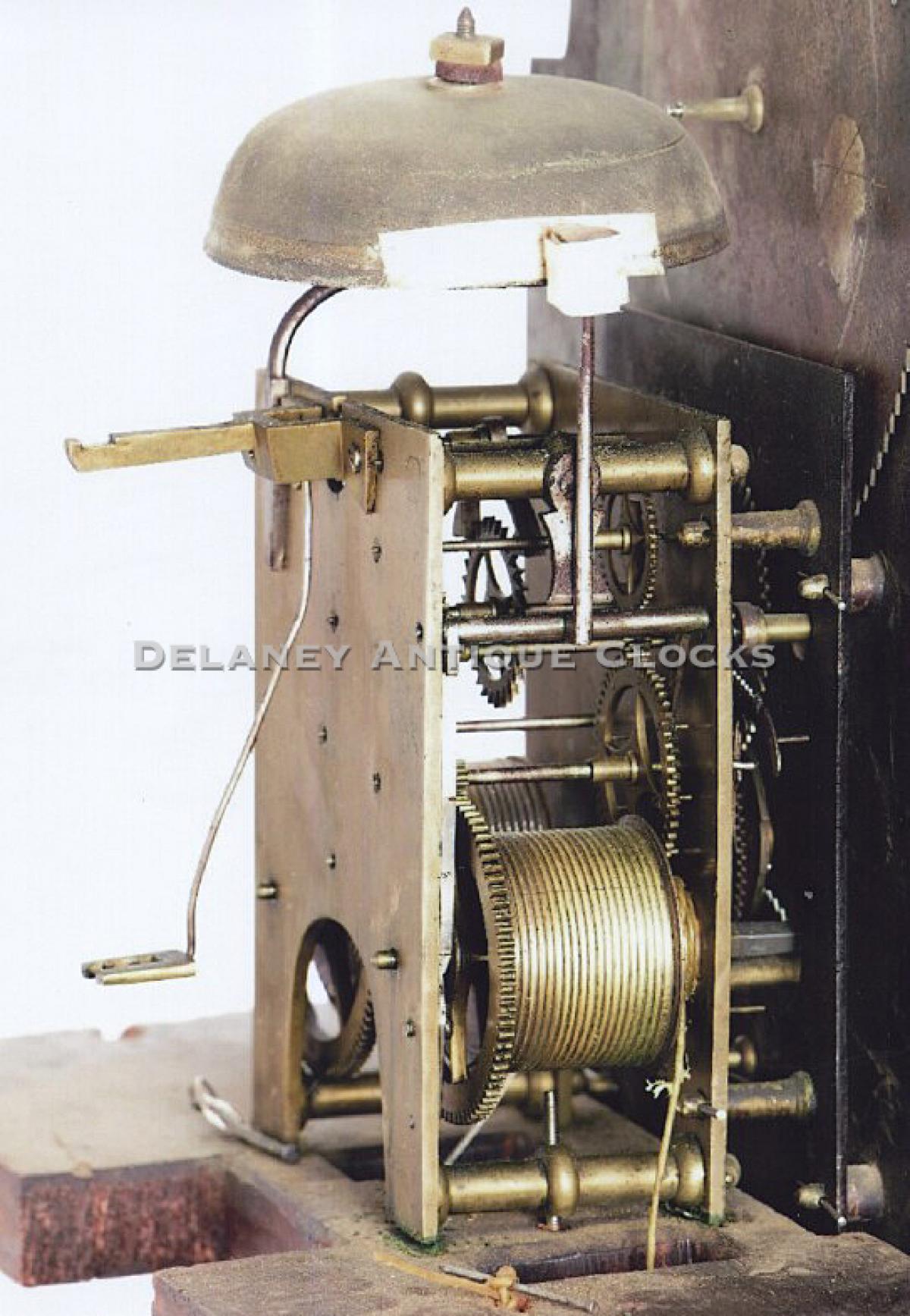
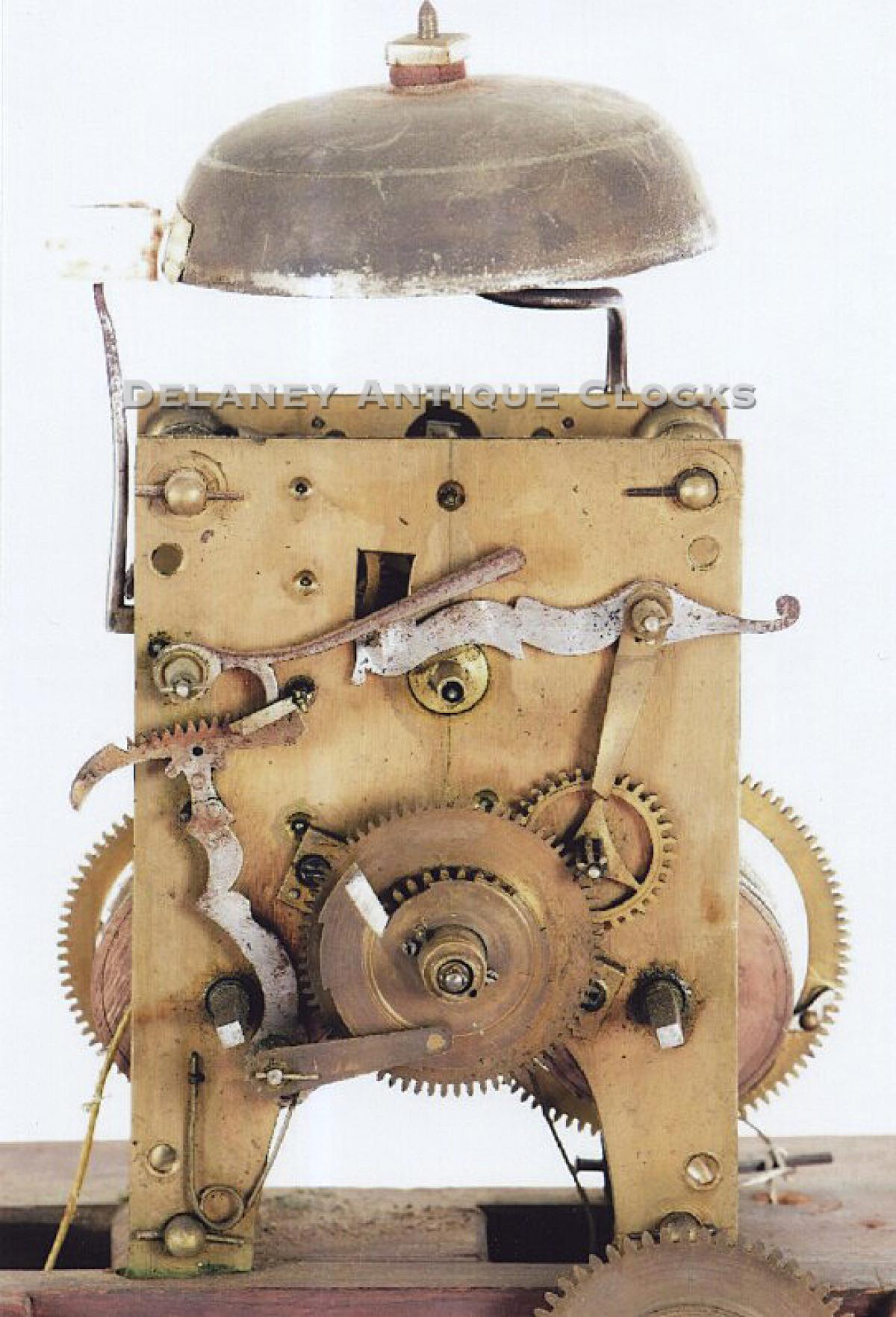
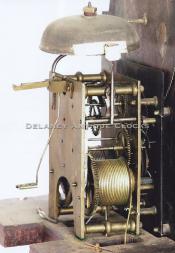
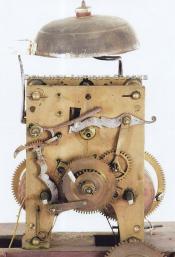
This fine movement is constructed in brass and is of good quality. Four-turned pillars support the two brass plates. Hardened steel shafts support the polished steel pinions and brass gearing. The winding drums are grooved. The escapement is designed as a recoil format. The weight-driven movement is designed to run for eight days on a full wind. The movement is a two-train or a time-and-strike design, having a rack and snail striking system. As a result, it will strike each hour on the hour. This is done on a cast iron bell mounted above the movement. It is interesting to note the unusual and distinctive shaping of the strike work. This design feature is also found on other clocks known that are signed by this North Shore clockmaker.
This fine example is nicely proportioned and stands a modest 7 feet 4 inches or 88 inches tall to the top of the center finial. As a result, it would fit nicely in many of the period homes of the day. This clock is 20.5 inches wide and 10.25 inches deep when measured at the upper hood molding. It was made circa 1815.
Inventory number 217003.
Ezra Batchelder was born in Andover, Massachusetts, on November 13, 1769. His parents were Ezra, a blacksmith (Baptized on May 31, 1741, and died in 1809), and his wife Mary (Woodbury) Ober of Beverly. They were married on March 15, 1763. They had five children that were raised on Maple Street. They became one of the largest landowners in Danvers.
Ezra had a brother, Andrew, born in 1772, who is also listed as a Clockmaker and blacksmith. They are listed as working together in Danvers sometime after 1801. It is thought that they were trained by their brother-in-law Nathan Adams. It is reported that an account book covers the business years of 1803 to 1830. In this 27 years of business, 36 clocks are listed as being sold. Not all of these are tall-case examples. These clocks are listed as selling for $35 to a high of $65 depending on whether they were cased. The names of the original purchasers are also listed in the account. It is also thought that both brothers were fine cabinetmakers and may have made their own cases as well as other wood products. The account book lists the following clock-related entries.
1803. Five clocks are listed. Nathaniel Lang purchased two at $50 each. Edmund Johnson bought two at $35 each. Charles Foster purchased one at $35. The Foster and Johnson clocks are listed as being sold with a "12-inch face with out case." The Lang clocks must have been sold with a case. 1803 was their busiest clock year.
1804-1805. No clock sales are listed.
1806. Peter Woodbury of Beverly purchased a clock with a "Moon face" for $40, and Solomon Dodge bought one at $37.50. A "Tucker "from Andover bought one for $38.
1807. Elias Endicott bought a cased clock at $52.50.
1808. Rev. Benjamin Wadsworth paid $50 for a clock to be delivered to Rev. Mr. "Bawlch" of Salisbury. Capt. Samuel Trow of Beverly bought a "moon face" for $45. William Dodge of Beverly bought a "moon Face" for $45. This clock was sold without a case. Mr. Lemon of Beverly bought a "12-inch moon face" for $43.
1809. No clock sales are listed.
1810. Amos Gould of Ipswich purchased a clock for $50.
1811. Jacob Towne of Topsfield purchased a "clock compleat" for $47.50.
1812. Capt. Thomas Raymond of Beverly bought a clock "without case" for $40. John H. Leonard of Salem bought a "compleat clock" for $55.
1813. Capt. Thomas Cheever of Danvers bought a clock for $65. (Capt. Cheever commanded the ship, Augustus.) This clock is listed as having a "mehogeny case." David Perkins of Topsfield bought a clock for $50.
1814. No clock sales are listed.
1815. Elezer Pope, a yeoman who resided in Salem, bought a clock for $50.
1816. Elezer Lake of Topsfield bought a "clock and case compleat and case varnished" for $52. John Averill of Topsfield is listed as buying a clock. The price is not recorded. Major Solomon Wilkins of Middleton paid $50. This is later sold to the Newhall family.
1817. No entries.
1818. No entries.
1819. Ebenezer Goldthwaite purchased a "clock and case compleat and case varnished" for $53. "Esq" Elezer Putnam paid $53 for a clock.
1820. Alen Porter bought a "compleat," clock for $53.
1821. Stephen Whipple of Salem bought a "compleat," clock for $53. Daniel Porter of Topsfield purchased a "clock and case" for $50.
1822. Capt. Asa Tapley of Danvers paid $53. He was a soldier of the revolution. He was a lieutenant during the War of 1812 and was on guard at Fort Lee. In 1833 he was granted a revolutionary pension. He was a successful businessman in all endeavors. He was one of the early brick manufacturers of Danvers. He served the Town of Danvers as a contestable, a highway surveyor, a member of the board of health, and on the school committee. He had many land transactions listed in the records. In these, he was listed as a yeoman.
1823. Levi Preston of Danvers paid $55.
1824. Mr. Killam, probably of Boxford, paid $40.
1825. No entries.
1826. Mark How paid $53.
1827. Mr. Hardy bought a clock "without case" for $32.50.
1828. Perley Tapley of Danvers bought a clock for $53. He was a famous mover of buildings. He also served as a highway surveyor.
1829. Hicks Richards of Danvers bought a clock "without case" for $38. Col. Nathan Tapley purchased "one case" for $15.75. Nathan was Asa's brother. He commanded a military company in Danvers and its vicinity, for which he received the title of Colonel. He was also a very successful businessman.
1830. Joseph Porter purchased "one eight-day clock with weights
without the case" for $38. (This is Ella J. Porter's clock. She lived on Cherry Street.)
Ezra married Anna Brown on December 17, 1795. She was a native of Andover, Massachusetts, and was born in 1772 and died on June 4, 1856. Together they had 11 children. Ezra was also a farmer and is reported to be the first expressman in Danvers, carrying merchandise to and from Boston in what was called a "road wagon." He did this in 1825-1830, making approximately three trips per week using two or a team of four horses depending on the weight of the load. He sold this route to Joseph Porter. Ezra died in Danvers on October 10, 1858, of lung fever. He lived nearly 90 years and labored to the end.
Over the last forty plus years of being in the business of selling clocks, We have seen at least 12 tall clocks signed by this Maker.