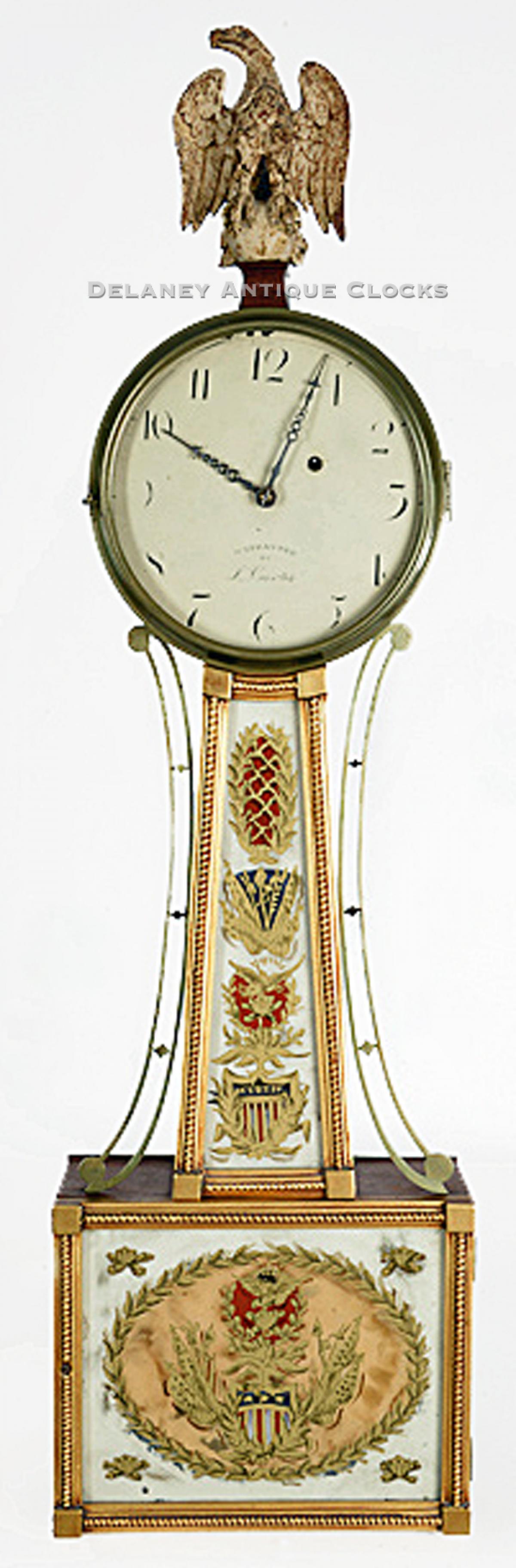
This is a fine Federal Massachusetts Wall Timepiece or Banjo Clock. It was made in Concord, Massachusetts by Lemuel Curtis. 217104.
This is a fine Federal Massachusetts timepiece or "Banjo clock" made in Concord, Massachusetts, by Lemuel Curtis. This clock was made circa 1820.
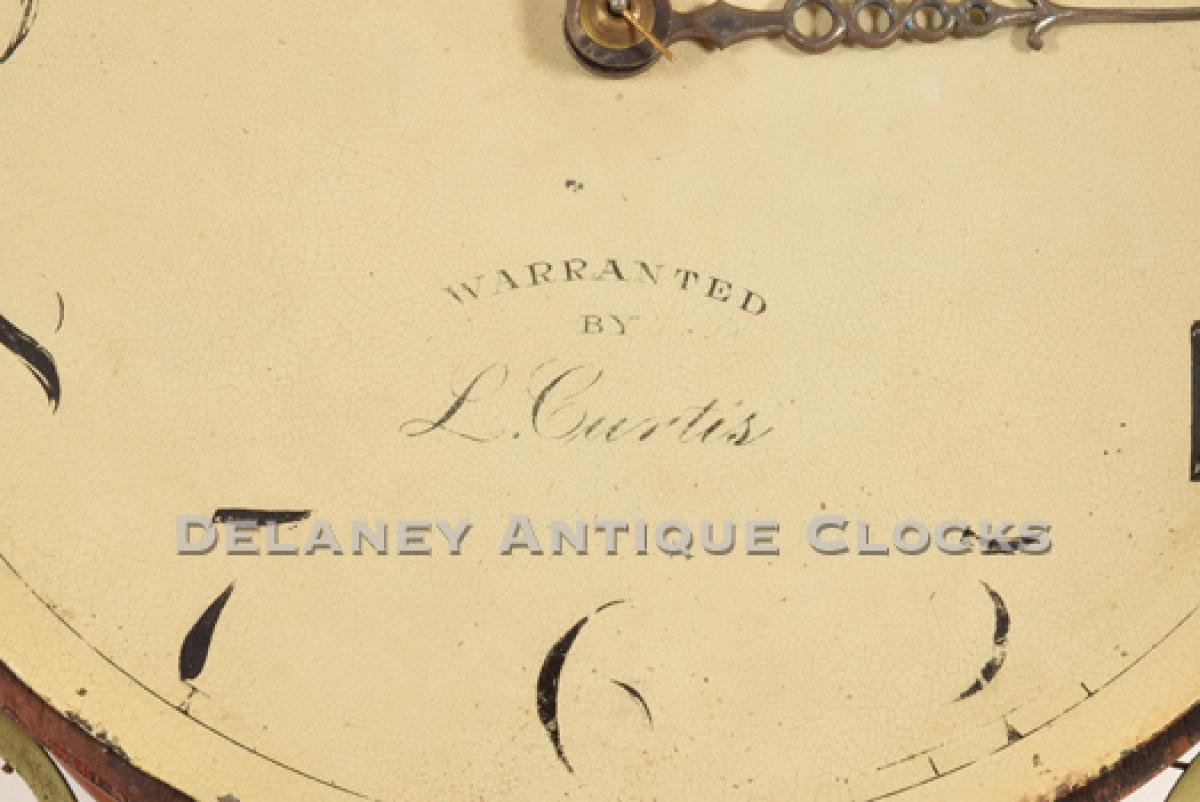
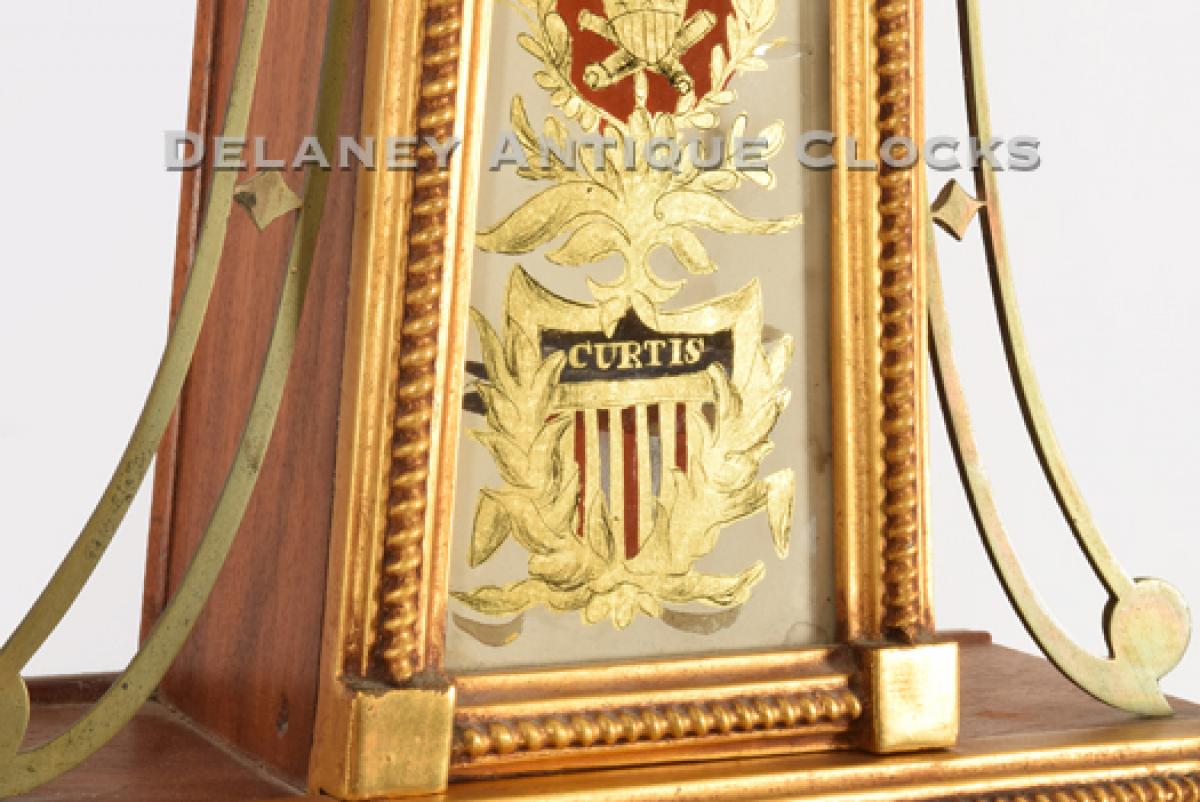
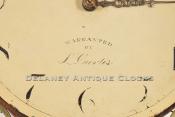
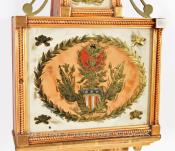
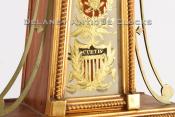
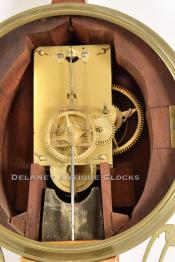
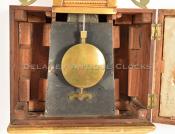
This is a wonderful, crisp, and clean example. The case is constructed in mahogany and features gilt frames that are decorated with rope turnings. The gilding appears to be original and is in excellent condition. Both frames are fitted with reverse-painted tablets. The tablets are original to this clock and remain brightly colored. Both tablets depict a number of patriotic themes. Some of these include an American shield, an American eagle, and a number of flags. The throat tablet is signed "CURTIS" in the red field of the shield depicted here. The bezel is fitted with glass, and the side arms are cast in brass. The bezel opens to access the painted iron dial. This dial features large Arabic-style hour numerals. It is also signed by the Clockmaker. The signature reads, "WARRANTED / BY / L. Curtis." The hands are filed from steel and are considered a signature form of this Maker. They are an exhibition of the Clockmaker's hand skills. These are wonderful. Behind this dial is a brass-geared weight movement that is designed to run for approximately eight days on a full wind. The movement is set in a Concord-style case having a very distinctive cutout in the head. It is mounted to the back of the case with a single screw. The plates are rectangular shaped. The bridge is a butterfly form, and the teeth in the gear train are deeply cut. The pendulum features a Concord-style keystone and a brass-faced bob. The tie-down is also shaped in the form of what one would expect to find in a clock made in Concord. At the top of the case stands a carved wooden finial. Much of the original gilding has been worn away over the years. The artistry in this carving is quite lovely.
This clock measures approximately 33.25 inches long overall.
Inventory number 217104.
Lemuel Curtis was born in Roxbury, Massachusetts, on July 3, 1790. He was the son of Samuel and Sarah (Partridge) Curtis, whose sister married Aaron Willard, making him his nephew. It is thought that Lemuel probably trained with Simon Willard in Roxbury. Lemuel had two brothers who were also involved with clockmaking. In 1811, he moved to Concord, MA, and took a shop near the Court House. At that time, Lemuel advertised that he was working on his own. On July 12, 1816, he was granted a patent for the girandole wall clock. This decorative form is considered by many to be America's most beautiful contribution to the market. Lemuel had two brothers who were also involved with clockmaking. His brother Benjamin Curtis may have painted a number of the glasses in his signed clocks. In 1820, he formed a partnership with Joseph N. Dunning. This partnership moved to Burlington, Vermont, in 1821. Their shop in Burlington was located at the corner of Church and College Streets in the Thomas Hotel. They worked there in collaboration until 1832. While in Burlington, they worked as clockmakers, silversmiths, and jewelers. Lemuel died in New York on June 17, 1857. Lemuel is known to have made girandoles, timepieces, lyre clocks, and shelf clocks.