
Joseph N. Dunning of Burlington, Vermont. Wall timepiece or gallery clock. Weight driven. PP-157.
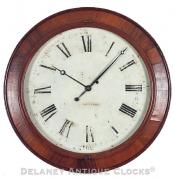

This is a very interesting weight driven wall gallery clock. It was made by Joseph N. Dunning of Burlington, Vermont. This example is signed on the large painted iron dial in a block format.
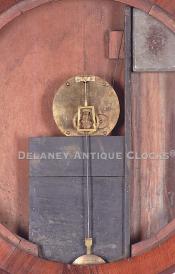
This case is constructed in New England white pine and has been veneered in figured mahogany and rosewood banding. The circular case measures 22.5 inches in diameter. A rosewood band is inlaid around the front facing frame. wooden bezel is mahogany and is fitted with glass. It opens from the bottom in order to access that painted iron dial. This dial measures approximately 18 inches in diameter and features Roman style hour numerals, Arabic style quarter hour makers and a closed time or minute ring. It is signed by the Maker below the center arbor in block lettering. The time is indicated by two hands that feature half moons out on the ends. The minute hand is counter balanced. The brass movement is weight driven or powered. The weight is compounded. This movement is designed to run eight days on a full wind.
This clock measures approximately 22.5 inches in diameter and is 3.25 inches deep. It was made circa 1825.
Joseph N. Dunning was born in Brunswick, Maine, on January 2nd, 1795, and died in Burlington, Vermont, on December 14th, 1841. He was first a journeyman working for Lemuel Curtis in Concord before they formed an informal partnership before 1820. In 1821, they formally advertised their partnership, and both men moved to Burlington, Vermont. It was during this period Burlington was experiencing an economic boom. There, they became two of Vermont's most prolific manufacturers of wall timepieces. They also sold watches and jewelry. In 1832, the partnership dissolved, and Dunning continued to work on his own. He died bankrupt at the age of 46.
For a further discussion on Vermont-made timepieces and the clockmaker Joseph Dunning, please read Paul Foley's book, "Willard's Patent Timepieces."


